


Your padel apparel should earn its place in your kit. It needs to feel comfortable through quick turns and long rallies, suit the conditions around match day and reflect your style.
Choosing what to wear can be less straightforward than it looks. Fit, comfort and weather all matter, as does versatility: the right pieces should work on court and feel composed before or after a session. You don’t need a crowded wardrobe. You need a considered one.
This guide explains how to assess fit and freedom of movement, choose clothing for indoor or outdoor play, and balance function with personal style. We’ll look at playing shirts and practical layers, including Pulco Studios’ Aircon Playing Shirt, Coaches Rain Jacket and Black Vent Gilet. You’ll also find a simple way to build a flexible kit without packing pieces you won’t use. Choose with purpose. Play with confidence.
Key Takeaways
- Choose padel apparel that supports your movement and suits the conditions, not just the look you want.
- Assess fit, freedom of movement, versatility and care before deciding whether a piece belongs in your kit.
- Compare playing shirts, lower-body pieces and outer layers by their role in your session. There’s no single kit for every player.
- Build your outfit around the session: consider indoor or outdoor play, choose a base outfit, then decide whether to add a layer.
- Explore Pulco Studios’ playing shirts, outerwear and hoodie tee to find pieces that balance function with a composed style.
What Does Padel Apparel Need to Do on Court?
Apparel should support your routine, not simply complete an outfit. You move, reach and reset throughout a match, so clothing should feel comfortable without needing constant adjustment. Think of padel apparel as the clothing you choose to play in, with movement, comfort and expected conditions in mind.
Padel combines fast exchanges with frequent changes of direction. You might move forward for a short ball, turn to cover a lob, then reach overhead to return it. Padel is a racquet sport combining elements of tennis and squash. Those varied actions make fit a practical consideration: a top that pulls when you raise your arms, or bottoms that feel restrictive when you step wide, can become a distraction.
Clothing can support comfort and help you feel composed on court. It can’t guarantee stronger shots, quicker reactions or better results. Focus on what you can assess: whether a garment stays comfortable through your usual playing movements and suits the conditions you expect. That’s a more useful standard than relying on a technical-sounding label alone.
- Check the fit while standing, reaching and bending, not only in front of a mirror.
- Notice whether fabric or seams pull, bunch or shift as you move.
- Consider the session: indoor or outdoor, warm-up or full match, mild or changeable conditions.
How Padel Movement Shapes Apparel Choices
Quick direction changes, overhead shots and repeated reaching ask different things of a garment. Raise both arms as if preparing for a high ball. Step wide in each direction, then bend and rotate as you would when reaching for a low shot. Notice whether a sleeve twists, a hem rides up or a seam catches your attention. Trying these familiar movements before play helps you spot a distracting fit before you’re in the middle of a rally.
Performance and Personal Style Can Work Together
Practical selection doesn’t require a uniform look. You might prefer a coordinated outfit with a consistent palette, or choose each piece for a distinct role and let the combination feel individual. Both approaches can work when fit and session needs come first. Pulco Studios’ technical padel apparel guide offers a closer look at the thinking behind clothing for court use. Keep your own priorities clear: comfortable movement, conditions, then the visual identity you want to bring to the match.
How to Evaluate Padel Apparel: Fit, Function, and Finish
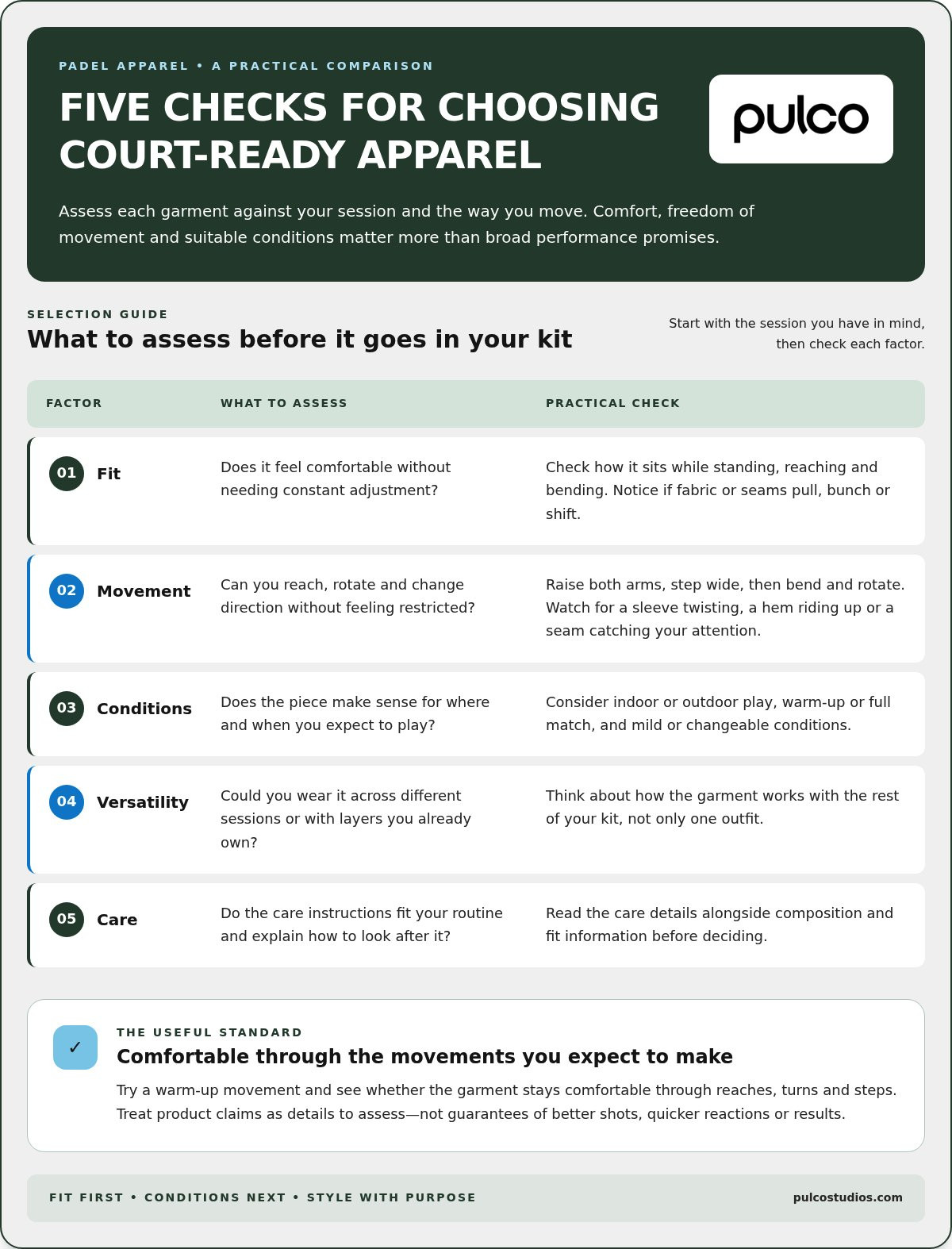
A sharp-looking garment is only a sound choice if it also suits the way you play. Evaluate each piece of padel apparel against clear criteria, not broad promises or technical-sounding labels. Start with the session you have in mind, then consider comfort, movement and how often the piece could work elsewhere in your kit.
Use this checklist before choosing:
- Fit: Does the garment feel comfortable without needing constant adjustment?
- Movement: Can you reach, rotate and change direction without feeling restricted?
- Conditions: Does the piece make sense for where and when you expect to play?
- Versatility: Can you wear it across different sessions or alongside layers you already own?
- Care: Do the care instructions fit your routine and explain how to look after it?
Comfort and mobility are better priorities than unsupported performance promises. A garment’s style or fit may affect how it feels to move, but that doesn’t mean a particular piece will improve your game. Treat product claims as details to assess, not guarantees of results. Your own fit check is straightforward: try a warm-up movement, then see whether the garment stays comfortable through the reaches, turns and steps you expect in a match.
Check Fit and Freedom of Movement
There’s no single correct level of tightness or looseness. Cuts and personal preferences vary. Focus on whether the garment feels comfortable as you raise your arms, rotate your torso and step from side to side. Check the shoulders, sleeves and hem during these familiar playing motions. If something pulls, rides up or distracts you, consider whether another fit or cut would feel more natural.
Read Product Details with a Critical Eye
Product details help set expectations. Composition tells you what a garment is made from; care instructions explain how to maintain it; fit information helps you judge how it may sit on your body. A named feature describes an attribute, while a measurable performance claim should explain what is being measured and how. Look for specifics rather than assuming a technical phrase proves an outcome.
Be precise in your own assessment, too. Don’t infer breathability, stretch, moisture management or durability from a garment’s name or appearance alone. Give comfort and movement the final say. For a practical comparison, notice how a shirt feels during a warm-up, then whether its fit remains comfortable through the motions you expect in a match.
Use these criteria to narrow your choices, then explore Pulco Studios apparel as you shape a kit around your preferences and playing conditions.
Padel Apparel Compared: Match-Day Shirts, Layers, and Versatile Pieces
Each garment has a different job. A useful comparison starts with the session, not a universal outfit formula. Build around the pieces you’ll wear during play, then decide whether the weather, warm-up or time around court calls for another layer. The right choice is the one that suits your routine and feels comfortable in motion.
| Garment role | Typical use | Selection question |
|---|---|---|
| Playing shirt | Part of your base outfit for a match or practice | Can you reach, rotate and move freely in it? |
| Shorts or skirt | Lower-body coverage during court movement | Does the fit feel comfortable when stepping, bending and turning? |
| Rain jacket | An outer layer to consider in wet or changeable conditions | Does this layer suit the weather you expect? |
| Gilet | An additional layer when you want an alternative to a jacket | Does its role and feel suit your warm-up or time around court? |
| Hoodie tee | A long-sleeve option for before or after a session | Will you use it beyond the moments you’re actively playing? |
Playing Shirts and Lower-Body Pieces
A playing shirt with suitable shorts or a skirt creates a straightforward court outfit. Judge the combination together: check that the top stays comfortable as you reach, and that the lower-body piece allows you to step and bend without distraction. Coverage and cut are personal choices, not a single standard. For a closer look at sleeve design, Pulco’s raglan sleeve padel shirt guide explores that garment detail.
Pulco Studios offers the Aircon Playing Shirt - Black and Aircon Raglan Playing Shirt Sky Blue as playing-shirt options. The Aircon shirts are moisture-wicking, and the raglan shirt offers a different sleeve style. Pair either with lower-body clothing that suits your movement and preferred coverage, then check that the whole outfit feels comfortable through a few match-like motions.
When an Additional Layer Makes Sense
A layer may earn its place before play, after play or when outdoor conditions change. Think about its role: a weather-resistant rain jacket is an outerwear option for wet or changeable conditions, while a gilet or hoodie tee offers a different layering choice. Pulco’s range includes the Coaches Rain Jacket, Black Vent Gilet and Racket Man Long Sleeve Cotton Hoodie Tee. Compare each with your routine, without assuming every layer belongs on court.
That distinction helps keep your kit considered. A jacket may be useful for the journey or conditions around a session; a gilet or long-sleeve piece may suit another moment in your routine. For more on the gilet’s place in a layered kit, see the technical padel gilet guide. Choose by role, then keep only the pieces you’ll reach for.
How to Build a Padel Outfit for the Session Ahead
A reliable kit starts with the session you’re actually playing. Indoor or outdoor court, expected conditions, and how long you’ll be around the venue all shape what belongs in your bag. Build in sequence: assess the session, choose a comfortable base outfit, then add a layer only if it has a clear purpose. That keeps your padel apparel practical, personal and free of unnecessary extras.
Use this simple order before you pack:
- Assess the session. Check whether you’ll play indoors or outdoors and consider the conditions you expect at arrival and during play.
- Choose your base. Select a playing top and lower-body piece that feel comfortable together and allow you to reach, rotate, bend and step freely.
- Consider a layer. Decide whether you’ll want an extra garment for arrival, breaks or changing outdoor conditions. Leave it behind if it won’t serve a likely need.
This approach gives each piece a job. It also makes it easier to spot gaps in your kit without defaulting to packing everything you own.
A Simple Pre-Session Outfit Checklist
Before heading out, check the full outfit as a combination. Move through a few comfortable playing motions and notice whether the top or lower-body piece shifts, pulls or distracts you. Consider practical coverage for the session, too. Finally, make sure the clothes are clean, comfortable and suitable for the plan. A quick check can help you catch an irritating fit before you arrive at court.
- Does the base outfit feel comfortable through full movement?
- Is an extra layer useful for arrival, breaks or expected conditions?
- Are all chosen pieces clean and appropriate for the session?
Adapt the Kit Without Overpacking
Pack for likely use, not every possible scenario. If the session is indoors and conditions outside are settled, a base outfit may be all you need. If rain or changing weather is part of the plan, a dedicated outer layer may make more sense. Pulco Studios’ Coaches Rain Jacket is a weather-resistant option; the padel coaches rain jacket guide explores that category in more detail.
Versatile pieces can simplify a regular kit when they suit more than one part of your routine. A long-sleeve hoodie tee, for example, may have a role before or after play as well as on the journey to the court. Choose based on how you’ll use it, rather than assuming every garment belongs in every session’s bag. A considered kit is ready without being overloaded.
Build your next session’s kit around pieces that fit your routine. Explore Pulco Studios apparel and choose with purpose.
Explore Pulco Studios Padel Apparel and Choose Your Kit
You’ve got the essentials for making a considered choice: start with the session, prioritise comfort and movement, then decide whether another layer has a clear role. Now apply that thinking to pieces you’ll actually wear. A useful kit doesn’t need to be extensive. It needs to suit your routine and feel like you.
Pulco Studios’ padel apparel spans playing shirts, outerwear and a long-sleeve cotton hoodie tee. Use the categories to shape a kit around your needs rather than treating every piece as a must-have. Consider what you’ll wear during play, what might help around the session, and which details match your personal style.
Choose from Pulco’s Confirmed Apparel Categories
For a playing-shirt option, consider the Aircon Playing Shirt - Black or the Aircon Raglan Playing Shirt Sky Blue. Both are moisture-wicking shirts, with a different sleeve design on the raglan option. Let your preferences and the way each feels guide your choice. Pair a shirt with lower-body clothing you already find comfortable, and assess the whole outfit through your usual range of movement.
For a different part of your routine, the range includes the Coaches Rain Jacket, Black Vent Gilet and Racket Man Long Sleeve Cotton Hoodie Tee. Think of these as outerwear or layering options, then choose according to when you expect to use them. A rain jacket, gilet and hoodie tee have different garment roles; the best fit for your kit depends on your plans, not a blanket rule about what every player needs.
Keep the decision grounded in clear product details. A product name identifies a garment, but it shouldn’t be taken as proof of a particular fit, material or performance result. Review the information provided for the piece and consider how it fits into your own playing routine.
Make the Kit Yours
Function and visual identity can sit side by side. You might build around a coordinated look, or select individual pieces for different uses and let your style emerge from the combination. Pulco’s story brings together Acapulco roots, where the brand was founded, and its establishment as a UK entity in 2021. That heritage informs its identity without implying where garments are manufactured.
The CIMORO x PULCO - Padel Pack is a collaboration designed for the specific demands of padel. Treat it as one route to a considered kit, not a reason to buy pieces that don’t suit your needs. Start with what your sessions call for, then choose the look that feels natural on and off court.
Ready to shape your kit? Explore Pulco Studios padel apparel and choose pieces that fit your routine and style.
Make Your Next Kit Choice Count
Your next step doesn’t have to be a complete wardrobe reset. Start with one question before your next session: what would make getting ready feel simpler or more comfortable? Perhaps you need a dependable base piece, or a layer you’ll actually use. Let that answer guide your choice.
The strongest padel apparel decisions are personal and practical. Choose with your own routine in mind, leave room for individual style, and make each new piece earn its place in your kit. A considered choice can bring more confidence to the moments before you step onto court, without promising results clothing can’t guarantee.
Explore pieces that bring court use and considered design together. Explore Pulco Studios padel apparel and find a considered next addition to your kit.
Choose with purpose. Then take that composed feeling into your next match.
Frequently Asked Questions
What should I wear to play padel?
Wear comfortable athletic clothing that lets you move freely, plus court-appropriate shoes. A playing top and shorts or a skirt are a practical starting point; choose coverage and cuts that feel right for you. Avoid clothing that restricts your steps or reaches, and skip jeans or sandals for play. If you’re new to the sport, keep your first outfit simple and adjust it after you’ve experienced a full session.
Is padel apparel different from regular gym clothing?
It can be, but it doesn’t have to be a separate category of clothing for every player. Padel involves lateral steps, turns and overhead reaches, so consider whether your gym clothes stay comfortable through those actions. Look at the garment’s stated use and details rather than assuming a “technical” label makes it suitable. The best padel apparel is the clothing that works for your court routine and preferences.
Can I wear a cotton shirt for padel?
Yes, you can wear a cotton shirt if it feels comfortable for your session. Think about how warm the venue is, how long you’ll play and whether you prefer a cotton garment during active play or around the match. Pulco Studios’ Racket Man Long Sleeve Cotton Hoodie Tee is one cotton option in its range. Check the garment details and your own comfort rather than assuming one fabric suits everyone.
Do I need a separate outfit for indoor and outdoor padel?
No, you may be able to use the same base outfit for both. The main difference is often whether you want an additional piece for outdoor conditions, such as rain or a cooler arrival. Indoor venues can also feel different from one another, so consider the specific setting rather than relying only on the indoor or outdoor label. Keep your regular base kit consistent and adapt extras to the day.
How should padel clothing fit for unrestricted movement?
It should feel secure enough to stay in place without pressing or pulling as you play. Try a few match-like motions, then check whether the waistband shifts, sleeves twist or the hem catches as you turn. Fit preferences vary, so don’t assume a close or relaxed cut is automatically better. If you’re between sizes, use the garment’s size guidance and focus on comfort through your normal range of movement.
What should I wear over my padel clothes before a match?
Choose an extra layer based on the journey to court and conditions around your session. A rain jacket may suit wet weather; a gilet or long-sleeve hoodie tee offers another layering option. You can remove an outer garment before playing if you no longer need it. Keep the layer easy to manage between arrival and match time, and avoid bringing several alternatives unless the forecast or your plans call for them.
How should I care for technical padel clothing?
Follow the care instructions on each garment’s label. Fabric composition and construction can differ, so don’t assume every playing shirt or outer layer should be washed or dried the same way. Check the label before choosing a wash cycle, temperature or drying method. If you’ve misplaced the instructions, look for product-care information for that exact garment rather than applying advice meant for a different material.
