


The club competition team plays in the Mexican Premier Padel League. The team uses the Pulco Aircon shirt. That makes the shirt relevant to a practical question for players and kit decision-makers: what should you look for in a padel shirt, and how can you decide whether it suits your game?
Team use provides context, not proof that a shirt improves results, reduces fatigue, or delivers a measurable performance advantage. Pulco Studios specializes in technical padel apparel, and describes its Aircon playing shirts as moisture-wicking. Those details can help guide your assessment, alongside your own preferences for fit, movement, and comfort.
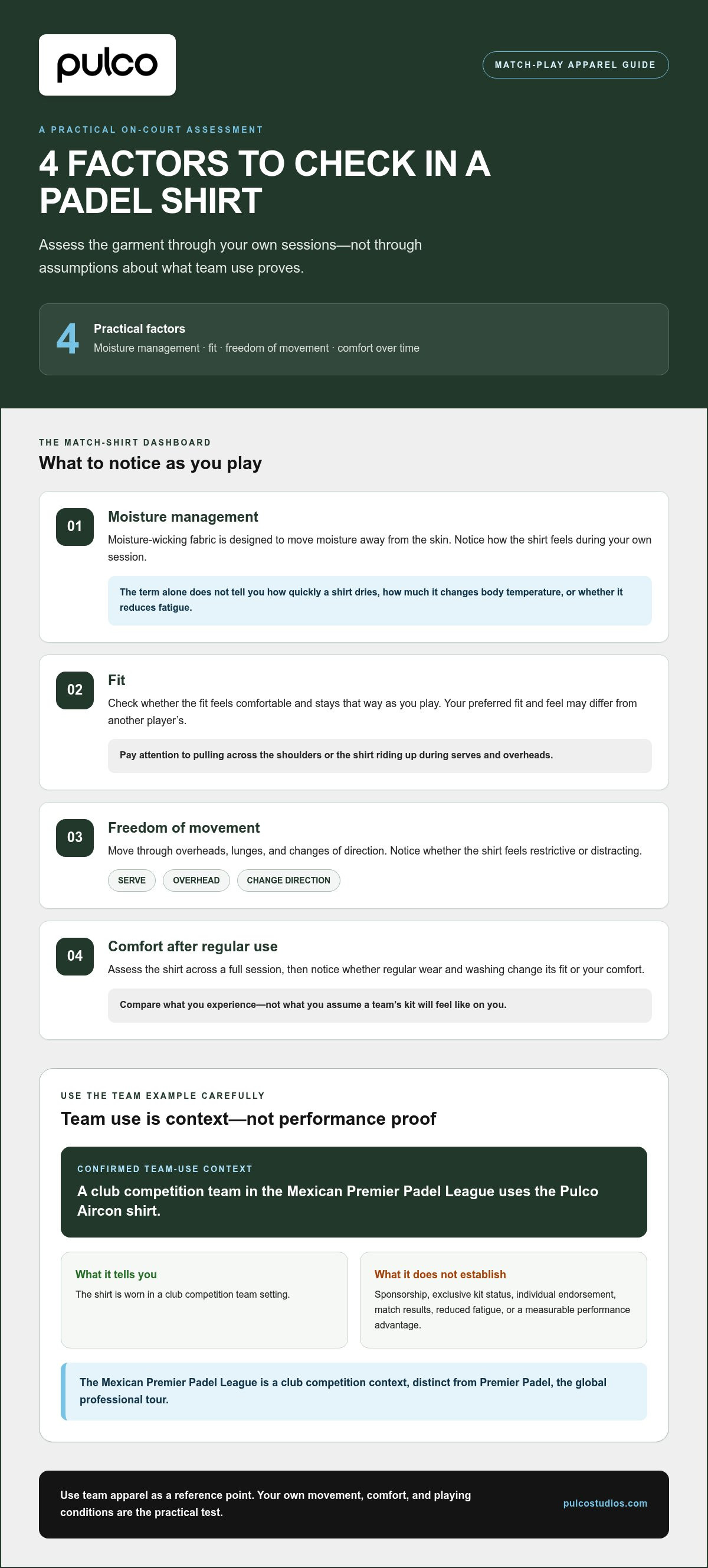
This article looks at what team use can tell you, which shirt qualities matter during match play, and how to evaluate a garment in your own sessions. The Mexican Premier Padel League is a club competition context, distinct from Premier Padel, the global professional tour.
Key Takeaways
- A club competition team in the Mexican Premier Padel League uses the Pulco Aircon shirt. Team use is context, not proof of sponsorship or improved results.
- Moisture-wicking describes a fabric function. It does not, by itself, promise cooling or reduced fatigue.
- Assess fit, comfort, movement, and garment care against your own playing conditions.
- Use team apparel as a reference point, then judge a shirt through your own playing sessions.
A Mexican Premier Padel League Team Uses the Pulco Aircon Shirt
A club competition team in the Mexican Premier Padel League uses the Pulco Aircon shirt. It is a real example of the shirt being worn in a competitive team setting, and a useful starting point when considering padel apparel.
The club competition team plays in the Mexican Premier Padel League. The team uses the Pulco Aircon shirt.
Team use says where the shirt is worn. It does not, on its own, show sponsorship terms, exclusive kit status, individual player endorsement, match results, or a measurable performance advantage. The useful takeaway for players is narrower: the Aircon shirt is part of a club competition team’s kit.
What is confirmed about the team and its shirt?
The team plays in the Mexican Premier Padel League and uses the Pulco Aircon shirt. Keep that statement separate from any claims about why the shirt was selected or how it affects play. Those are different questions from whether the team wears it.
The league wording also deserves care. This club competition context is distinct from Premier Padel, the global professional circuit. Wikipedia’s overview of Premier Padel provides context on that circuit’s organization and history.
Why does a team-use case study matter to players?
Team use gives shoppers a concrete reference for a shirt in a competitive padel kit. It can make the product relevant to your own match-kit decision, without implying that wearing it will change your results. Adoption is one kind of information; claims about improved movement, reduced fatigue, or better match performance require evidence of their own.
For your kit, focus on what you can assess directly: comfort through a session, freedom to move, and how the shirt manages moisture. Pulco Studios describes its Aircon playing shirts as moisture-wicking. Treat that as a product feature to consider, not a guarantee of cooling or a particular match outcome. For a closer look at the garment, explore the Aircon Playing Shirt guide.
Team use offers useful context for a competitive apparel decision. Your own comfort and priorities determine whether the shirt belongs in your match kit.
What a Padel Competition Shirt Needs to Do During Match Play
Padel involves repeated overheads, quick changes of direction, and long rallies. A shirt will not determine the score, but an uncomfortable fit can distract you. When comparing playing shirts, focus on practical factors: moisture management, fit, freedom of movement, and how the garment feels after regular use.
How does moisture management fit into a playing shirt?
Moisture-wicking apparel is designed to move moisture away from the skin. The term describes how fabric manages moisture. By itself, it does not tell you how quickly a specific shirt dries or how much it changes body temperature, and it does not establish reduced fatigue or improved play.
Pulco describes its Aircon playing shirts as moisture-wicking. Consider that feature alongside how the shirt feels during your own sessions, rather than treating it as a promise of a specific sensation or result. For more fabric context, read the breathable padel shirt guide.
Which shirt qualities matter across a competitive match?
Start with movement. During a serve or overhead, notice whether the shirt pulls across your shoulders or rides up. When you lunge or change direction, check whether the fit feels restrictive or distracting. These are personal checks, since players differ in their preferred fit and feel.
Then assess comfort over the full session, not just when you first put the shirt on. Notice whether the fit remains comfortable as you play, and whether it continues to suit your movements. After regular wear and washing, pay attention to any changes that affect your comfort or the way the shirt fits. This gives you a more useful basis for comparison than assuming a team’s kit will feel the same on you.
The Official Premier Padel Website covers the professional circuit, a separate reference from this club-team example. Whatever shirt you consider, use the same practical test: move through serves, overheads, and changes of direction, then assess comfort and moisture management without treating them as performance guarantees.
How to Read the Pulco Aircon Team Case Without Overstating It
The team-use example shows the Pulco Aircon shirt in a club competition setting. It does not explain why the shirt was selected or establish what difference it makes on court. Keeping those questions separate makes the example more useful for players choosing apparel.
Team use shows where a shirt is worn, not what it makes a player achieve. That distinction keeps the discussion fair to the team and useful to anyone comparing match shirts.
What does team use establish, and what does it not establish?
That fact does not establish sponsorship, exclusive kit status, or individual player endorsement. It also does not connect the shirt to wins, rankings, endurance, or reduced fatigue. Each of those claims would need evidence beyond the fact of use.
Which evidence makes an apparel case study more useful?
Specific details help readers understand a team-use account. Team identification, dates, and competition context clarify where and when a shirt was worn. First-hand player feedback can add insight into fit or comfort when comments are accurately attributed and approved for publication. Match imagery can document use, but it cannot show performance impact on its own.
Measured outcomes call for particular care. A report should explain what was measured and how. Without relevant evidence and documented methods, an observation should not be presented as a cause of a particular result.
| Evidence level | What it supports | What it doesn’t support |
|---|---|---|
| Team-use fact | A club competition team uses the Pulco Aircon shirt. | Sponsorship, exclusivity, or endorsement. |
| Practical context | Team use offers a real-world reference when considering a shirt for a competitive kit. | A claim that every player will find the shirt comfortable or suitable. |
| Additional evidence | Verified interviews, dated match imagery, or documented test results can support more specific reporting. | Claims of improved results, rankings, endurance, or reduced fatigue without supporting evidence. |
This approach keeps the takeaway clear: the team uses the shirt, while that fact alone does not establish a competitive effect.
How Players Can Apply the Case Study to Their Own Padel Kit
Team use can give you a reference point, but your playing conditions and preferences should guide your decision. A shirt that works for one team or player will not necessarily feel right for everyone.
How should players assess a shirt for their own matches?
Start with where and how long you usually play. Then decide what matters most to you: the feel against your skin, moisture management, or freedom of movement. Pulco describes its Aircon playing shirts as moisture-wicking, but comfort is best judged in your own play.
- Consider your conditions: Think about where you usually play and the length of your sessions.
- Test movement: Try serves, overheads, lunges, and quick direction changes. Notice pulling, riding up, or anything that distracts you.
- Assess comfort during play: Pay attention to how the shirt feels over a session, not only when you first put it on.
- Follow garment care: Use the shirt’s care instructions and notice how it feels after washing and regular wear.
Your experience can vary between sessions and playing conditions. A fit that feels comfortable to one player may not suit another. For more moisture-management context, see the anti-sweat padel shirt guide.
What can a team kit teach individual players?
Team use shows that the shirt is worn in a competition setting. It can prompt useful questions about your own match kit, but it does not determine your personal fit, comfort, or performance outcomes. Those are yours to assess.
Keep apparel in its lane, too. A shirt is one part of your kit. Racket choice, footwear, coaching, and training are separate decisions with different roles. Assess each on its own merits, then build a setup that feels right for your game.
Once you know your comfort and movement priorities, explore Pulco technical padel apparel as you consider your playing-shirt options.
Pulco Aircon in Competitive Padel: The Takeaway for Teams and Players
A club competition team in the Mexican Premier Padel League uses the Pulco Aircon shirt. This makes the shirt relevant to a discussion of competitive padel apparel, without establishing a particular match result or physical benefit.
For individual players, the practical question is whether the shirt’s stated moisture-wicking feature and its fit suit their sessions. For teams and kit decision-makers, the example is a prompt to weigh product qualities against the group’s needs.
What is the practical takeaway for club teams?
Team use offers a reference point, not a complete uniform assessment. A club choosing kit can consider the shirt’s moisture-wicking description alongside practical priorities, such as how players want their clothing to feel and move during play. One team’s use does not prove that a shirt suits every squad or improves competitive outcomes.
Keep the decision grounded: distinguish product features from assumptions and weigh them against the team’s requirements. A useful kit decision starts with what players value and what the garment is described as doing, not an inflated performance promise.
Where can players explore Pulco Aircon?
The Pulco Aircon shirt is a padel playing-shirt option described as moisture-wicking. Consider its fit and comfort in your own sessions, then decide whether it belongs in your kit. For more apparel context, read the quick-dry padel shirt guide.
Choose with clarity: judge the Pulco Aircon shirt by the qualities that matter to your game.
Choose Your Match Shirt with Confidence
A Mexican Premier Padel League club competition team uses the Pulco Aircon shirt. That is a real-world apparel example, not proof of sponsorship, individual endorsement, or improved results. It is useful context, not a promise of cooling, reduced fatigue, or competitive advantage.
For your own decision, consider your playing conditions, comfort priorities, and freedom of movement during a session. Team use adds context; your experience helps determine whether the shirt suits your kit. Pulco Studios specializes in technical apparel for padel, with clothing designed for the sport and its community.
Explore Pulco Aircon and technical padel apparel and choose your next match shirt based on what matters to your game.
Frequently Asked Questions
Does a Mexican Premier Padel League team use the Pulco Aircon shirt?
Yes. A club competition team in the Mexican Premier Padel League uses the Pulco Aircon shirt. That establishes team use, not sponsorship, exclusive kit status, individual player endorsement, or match results.
What does a team using the Pulco Aircon shirt tell players?
It gives players a real-world example of the shirt in a club competition setting. That context can inform a match-kit decision, but it does not show why the team chose the shirt or whether every player finds it comfortable. Consider your fit preferences and playing conditions, then assess the shirt during your own sessions.
Does wearing a technical padel shirt improve match performance?
Team use or technical apparel features alone do not establish improved match performance. A shirt may have qualities relevant to comfort, but claims about wins, endurance, fatigue, or competitive advantage need supporting evidence. Choose apparel for its stated features and how it feels during play, not for assumed results. Performance on court involves many factors, so a shirt choice is not proof of a sporting outcome.
What does moisture-wicking mean in a padel playing shirt?
Moisture-wicking describes fabric designed to move moisture away from the skin. It refers to moisture management, not a guaranteed feeling of coolness or a specific drying speed. Your experience across playing sessions can help you decide whether the shirt’s feel suits your preferences.
How should I choose a shirt for competitive padel?
Start with your playing environment and typical session length, then identify your comfort priorities. During a session, notice whether the shirt feels comfortable and allows you to move through serves, overheads, lunges, and quick changes of direction. Consider the garment’s stated qualities without assuming they guarantee a particular outcome. Your assessment of fit, comfort, and movement is more useful than team use alone.
Is the Pulco Aircon shirt suitable for club competition?
A club competition team uses the Pulco Aircon shirt, so it is a relevant option to consider for a club match kit. Suitability for you depends on personal fit, comfort, and how the shirt feels during play. Team use provides context, not proof of universal fit or competitive advantage.
What evidence should a padel apparel case study include?
A useful case study identifies the team, competition context, and dates. First-hand player feedback should be accurately attributed and approved for publication. Match imagery can document shirt use, while performance claims need measured results and a clear account of how they were assessed. Keep observations distinct from conclusions: wearing a shirt shows use, not that it caused a result.
