


The world's fastest-growing sport wasn't born in a stadium, but behind the walls of a private Mexican summer home in Acapulco in 1969. It was a high-stakes solution for the wealthy businessman Enrique Corcuera. He wanted tennis. He lacked the space. He built walls. He used wooden paddles. He created an elite subculture that defined the jet-set lifestyle. This wasn't just a game. It was an invention born of necessity and refined by exclusivity. It was enjoyed by the fun-seeking celebrity elite that visited Acapulco in its glory years of hedonism.
You've likely seen the sport's rapid rise, but generic histories often miss the soul of the game. It's easy to confuse padel with its slower cousins, yet the real story is one of innovation under the Mexican sun. Discover the high-stakes history of how a backyard innovation in Acapulco became the world's most exclusive sport. We'll take you inside the original 1969 court and the story of the Acapulco Diving & Padel Club to see how this heritage shaped modern performance. Understand the elite roots that demand technical precision. We'll link the original 1969 climate to the advanced engineering of the Aircon Playing Shirt. This is where tradition meets the future.
Key Takeaways
- Understand the architectural constraints that birthed the 20x10 metre court and changed racket sports forever.
- Discover the exclusive history of how padel invented in Acapulco 1969 evolved from a private backyard solution into a global phenomenon.
- Learn how the sport's migration to Marbella turned a local Mexican pastime into the preferred game of the European aristocracy.
- Connect the high-energy lifestyle of Hollywood's Golden Age to the competitive spirit of the modern pro circuit.
- Explore how original Acapulco heritage drives the engineering behind technical apparel like the Aircon Playing Shirt.
The Genesis: Enrique Corcuera and the 1969 Breakthrough
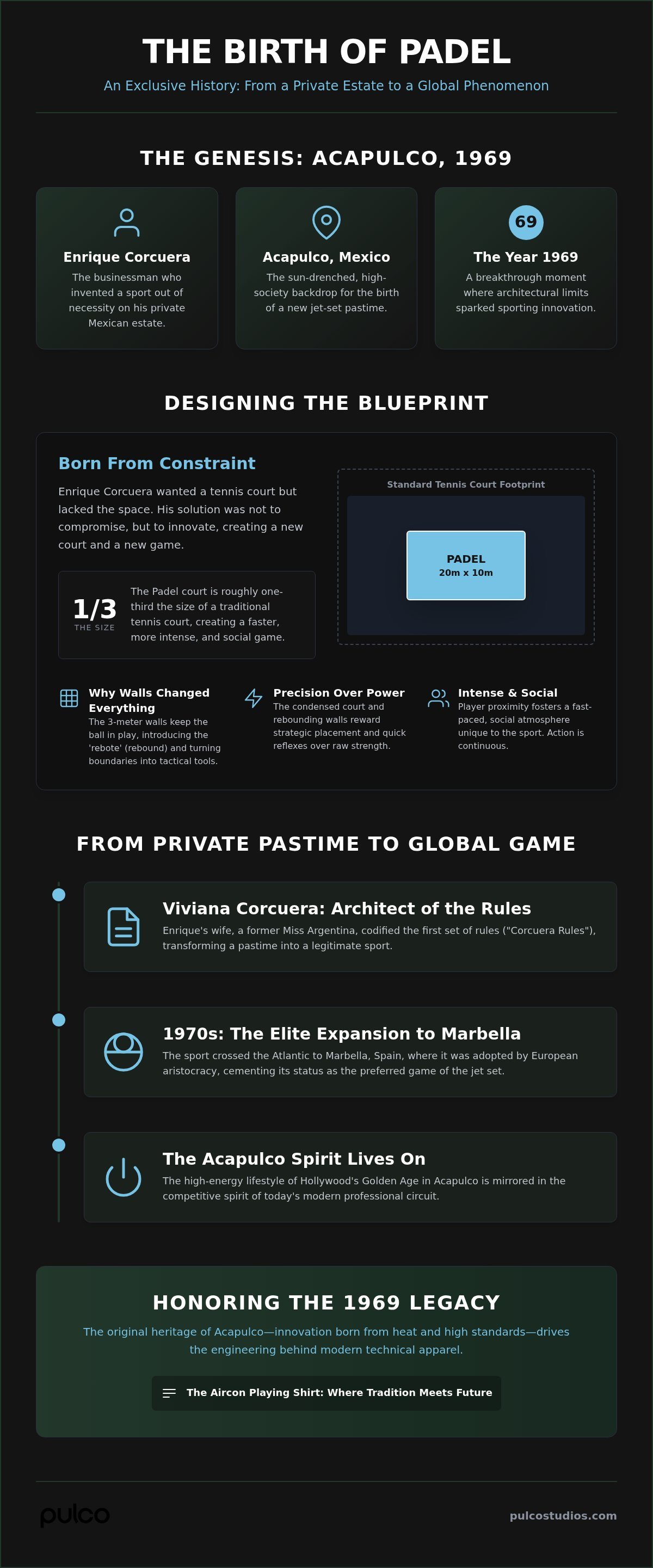
Acapulco. 1969. The air is thick with heat, salt, and ambition. Enrique Corcuera, a businessman born in 1933 with a penchant for high-society leisure, faced a dilemma at his Las Brisas estate. He wanted a tennis court. The rugged terrain of the Mexican coast and the existing walls of his property said otherwise. Instead of conceding to the landscape, Corcuera chose to innovate. This was the moment Padel was born. It wasn't a corporate boardroom decision; it was a backyard breakthrough driven by physical constraints and a refusal to compromise on an active lifestyle. The neighbours objected, the authorities tried to block the planning application, but the rebellious Corcuera fought the establishment and won.
The result was a 20x10 metre masterpiece. By incorporating three-metre walls to keep the ball within the small footprint, Corcuera inadvertently created a tactical game that prioritized precision over raw power. History records that Padel invented in Acapulco 1969 began as a private luxury. It was a specialized game for the inner circle of Mexican high society, designed for those who appreciated the marriage of athletic intensity and effortless aesthetics.
The Birth of Padel at Las Brisas
The estate at Las Brisas provided the perfect laboratory. Corcuera dealt with a space roughly half the size of a standard tennis court. He used the walls to enclose the area, preventing balls from disappearing into the lush tropical overgrowth. When the Acapulco elite first stepped onto this miniature court, the reaction was immediate. It was faster. It was more social. It felt exclusive because it was. These first matches weren't just games; they were the foundation of a new sporting heritage. The proximity of the players and the strategic use of the walls created a unique rhythm that traditional tennis couldn't match.
The court was built adjacent to the house. Three new concrete walls and the fourth wall was the back wall of the house. Inconveniently, that back wall housed a white aircon unit for the kitchen. As the players became more serious and competitive, they asked for the unit to be removed. Mrs Corcuera stood firm. "The Aircon stays. The ball bounces where it bounces. That's life". To this day, modern courts feature the Grill. Off the grill, the ball bounces, where it bounces. Sometimes up, sometimes down. Life's not always fair.
Viviana Corcuera: The Architect of the Rules
A sport needs more than a court. It needs a code. Viviana Corcuera, a former Miss Argentina and Enrique's wife, provided the strategic foresight the game required. She codified the first set of rules as a birthday gift for her husband. This wasn't merely a romantic gesture. It was a technical blueprint. She balanced the high-energy nature of the game with structured play, ensuring it could scale beyond their private residence. By the time the sport began its global expansion in 1975, her "Corcuera Rules" had already set the standard. Her contribution transformed a family pastime into a legitimate discipline. It proved that while Enrique built the walls, Viviana built the game. This legacy of precision and performance in the Mexican heat is exactly why we engineer technical gear like the Aircon Playing Shirt today.
Designing the Blueprint: How Limited Space Created a Global Phenomenon
The architecture of padel wasn't a happy accident. It was a strategic pivot. Enrique Corcuera’s 20x10 metre blueprint redefined the geometry of racket sports. When Padel invented in Acapulco 1969 first appeared, it replaced the expansive tennis court with a condensed, high-pressure environment. Power became secondary. Precision became everything. This wasn't just a smaller court; it was a new way to compete.
The 20x10 Metre Innovation
Space is a luxury. In padel, it is a weapon. The 20x10 metre court forces players into a proximity that demands lightning-fast reflexes. Compared to a standard tennis court, the playing area is roughly one-third the size. The pace is relentless. There is no time for long backswings or defensive resets. Every shot is a calculation of angles. Because the game is played in such tight, high-intensity quarters, technical padel apparel is essential to manage the physical strain and heat of constant movement. The court size dictates a specific athletic profile: agile, explosive, and disciplined.
Why Walls Changed the Game Forever
The walls are not boundaries. They are participants. Corcuera’s three-metre walls introduced the 'rebote' (rebound), a mechanic that allows the ball to remain in play after it passes the player. This changed the psychological landscape of the match. The International Padel Federation recognizes this specific enclosure as the sport's defining characteristic. It transformed the game into a chess match played at high speed.
- Continuous Action: No more chasing stray balls. The heart rate stays in the red zone.
- Strategic Depth: The back wall becomes a teammate, allowing for defensive lobs and counter-attacks from impossible angles.
- Mental Pressure: The enclosed 'cage' creates a feeling of intense focus. There is no escape from the rally.
The transition from the original wooden paddles to modern technical rackets mirrors the evolution of the sport. The early paddles were rigid and heavy, suited for a leisurely backyard game. Today, carbon fiber and specialized foam provide the power needed for the professional circuit. This shift from amateur innovation to elite performance is why we prioritize high-register craftsmanship in every piece of gear. If you are ready to elevate your game, explore our latest engineered performance gear designed for the modern court.
From Acapulco to Marbella: The Elite Expansion of the 1970s
Padel was a private revolution. It required a global curator to scale beyond the walls of Las Brisas. Prince Alfonso of Hohenlohe, a close friend of Enrique Corcuera and founder of the iconic Marbella Club, provided that bridge. During a summer visit to the Corcuera estate, Alfonso didn't just see a game; he saw a lifestyle that belonged on the Mediterranean coast. Padel invented in Acapulco 1969 was about to become a global phenomenon for the international jet-set.
Prince Alfonso and the Spanish Connection
Alfonso was captivated by the strategic intensity of the game. In 1974, he returned to Spain and commissioned the first two European courts at the Marbella Club Hotel. He made slight modifications to the court design to improve playability, but the core DNA remained purely Mexican. The Spanish aristocracy adopted the sport with immediate fervor. It was fast, social, and exclusive. Within years, padel became the definitive status symbol for the European elite. It was the sport of princes and billionaires, played in the sun-drenched privacy of Andalusia's most prestigious clubs.
The 1975 Club Merger: A Cultural Milestone
In 1972 some friends built a padel court in the Quebrada, close to the diving cliffs. The padel players would go to the divers' cabana after games to share beers and coffee. Padel became popular in Acapulco and soon they built a second and then a third court. The small cabana soon became too small.
They spoke to their friends, the divers, and soon there was an agreement to amalgamate the diving club and the padel club. The new club would be called the Acapulco Diving & Padel Club and together they built a larger clubhouse. That clubhouse and its grounds have since further developed into one of the finest Padel clubs in the world. They don’t claim to be the best padel club in the world, but they certainly have the finest views in the world. The Pacific sunsets are legendary.
The merger of the Acapulco Diving & Padel Club solidified the game's cultural weight. This wasn't just a merger of facilities; it was a merger of philosophies. By linking padel to the world-famous cliff divers of Acapulco, the sport gained a reputation for high-adrenaline athleticism. This era standardised the "Acapulco style" of play, which emphasised a blend of high-stakes precision and effortless aesthetics. It moved padel from a backyard novelty to a legitimate discipline with its own specialised community.
This heritage is the foundation of our brand. We don't just manufacture apparel; we guard a legacy of elite performance. The transition from the 1970s jet-set era to the modern professional tour requires gear that respects tradition while pushing boundaries. Our Aircon Playing Shirt is engineered for this exact lineage. It handles the intensity of a high-stakes match with the same technical precision required by those original innovators in the Mexican heat. Performance is in our DNA. Heritage is our guide. Explore the collection and feel the legacy of 1969 in every stitch.
The Acapulco Spirit: From Hollywood Stars to High Performance
Acapulco in the mid-20th century was the world's most exclusive stage. It was a sun-drenched arena for the bold. While Padel invented in Acapulco 1969 provided the elite with a new tactical outlet, the city's reputation for high-stakes adrenaline was already well-established. This spirit of daring performance defines the sport to this day. It is a blend of high-energy movement and sophisticated leisure that traditional tennis could never replicate. In Acapulco, you didn't just play; you performed.
The Celebrity Influence in the 1970s
The courts at Las Brisas and the burgeoning clubs nearby became magnets for Hollywood royalty. Frank Sinatra, Elizabeth Taylor, Elvis Presley and the Kennedys frequented the Mexican coast and brought an immediate "cool factor" to the game. These stars weren't looking for the rigid etiquette of the country club. They wanted the fast-paced, social intensity that Enrique Corcuera’s innovation provided. Celebrity endorsements turned padel into an insider's secret. It was the sport you played if you were part of the global vanguard. This exposure transitioned the game from a private backyard pastime into a competitive pursuit, fuelling the rise of the first club tournaments that challenged the social elite to prove their athletic mettle.
Cliff Diving and Padel: Acapulco’s Dual Legacy
The city's identity is rooted in bravery. The world-famous cliff divers of La Quebrada began their tradition in 1933, long before the first padel court was built. There is a direct line between the courage of those divers and the intensity required on a padel court. Both disciplines demand absolute focus and a refusal to back down under pressure. When the Acapulco Diving & Padel Club became a central hub in 1975, it solidified this dual legacy of prestige and adrenaline. Padel isn't just a racket sport. It is a continuation of the daring Acapulco spirit that values performance above all else. This shared heritage of excellence is why we engineer gear that stands up to the most demanding conditions.
Today, the sport has evolved from a social pastime of the stars into a professional athletic pursuit. The stakes are higher. The pace is faster. The gear must be better. We design for the athlete who respects this history but plays for the future. Own the legacy of the original innovators. Enjoy the Aircon Playing Shirt and perform with the confidence of an Acapulco original. It is time to lift your game to the high-performance standards of the elite circuit.
Pulco Studios: Honouring the 1969 Legacy with Technical Innovation
Pulco Studios was founded in the birthplace of the sport. We are the modern guardians of a revolution. Padel invented in Acapulco 1969 wasn't just a backyard innovation; it was the start of a global subculture. We've taken that spirit and injected it into high-performance technical apparel. This is heritage you can wear. It is performance you can feel. We exist where it all began, and we bridge the gap between the original Las Brisas courts and the modern professional circuit.
The transition from social leisure to global dominance requires a technical shift in gear. We don't just respect the history. We engineer for it. The intensity of a high-stakes match in 2026 demands more than aesthetic appeal. It requires precision. It requires discipline. We provide the technical edge for a specialised community that values both tradition and future-focused performance. Heritage isn't a museum piece. It's a performance standard.
Transitioning from Heritage to High-Performance Apparel
Respecting the past means engineering for the future. As we look toward the 2026 season, the physical demands on players are higher than ever. The humid Mexican climate taught us the value of moisture management. We use high-register technical terminology because our fabrics are engineered, not just sewn. Our minimalist design aesthetic mirrors the architectural precision of the first 20x10 metre courts. It is a clean, urban edge for a sophisticated athlete who demands effortless aesthetics on and off the court. We focus on the relationship between how you perform and how you present yourself.
The Aircon Advantage: Modern Gear for an Ancient Heat
Elite performance requires elite equipment. The Aircon Playing Shirt - Black is the result of years of refinement. It is built for the intensity of the pro circuit and the heat of the Mexican coast. Why settle for general tennis apparel when you can wear gear designed for the cage?
- Thermal Regulation: Engineered for the same intense heat where the sport was born in 1969.
- Raglan Sleeve Engineering: This is essential for the overhead smash. This movement was perfected in Acapulco and demands zero restriction.
- Moisture Management: High-level functionality that keeps you dry during the most grueling rallies.
- Unapologetic Style: A bold, premium aura that signals your status as an insider in the padel community.
Embody the heritage. Play with the best gear. The evolution of the sport is happening now. Don't just watch it. Lead it. Own the court with the confidence of an Acapulco original.
Own the Court, Own the Legacy
Padel is more than a game. It is a strategic masterpiece born of necessity. From the first 20x10 metre court at Las Brisas to the professional circuits of 2026; the sport remains a symbol of elite performance. You've seen how Padel invented in Acapulco 1969 transformed from a private backyard innovation into a global phenomenon. It moved from the Mexican heat to the Spanish aristocracy; eventually capturing the world's fastest-growing racket sport market.
This heritage demands more than standard apparel. It requires precision engineering. Pulco Studios was founded in Acapulco to protect this legacy. Our gear is designed for the same intense conditions where the sport began. We deliver technical apparel engineered for elite performance; worn by professional competitors who refuse to compromise on aesthetics or functionality. It is time to align your gear with your ambition.
Shop the Heritage: Explore Pulco Studios Technical Apparel
Step into the cage with the confidence of an original. The game is yours to lead.
Frequently Asked Questions
Who exactly invented Padel in 1969?
Enrique Corcuera, a Mexican businessman and socialite, is the sole inventor of the sport. He created the game at his private estate in Las Brisas, Acapulco. Corcuera wanted a tennis court but lacked the necessary acreage on his rugged property. His solution was a smaller court with walls. His wife, Viviana, later codified the first official rules to formalize the discipline for their elite social circle.
Why is the year 1969 so significant for Padel history?
The year 1969 marks the official transition from backyard innovation to a distinct athletic discipline. Padel invented in Acapulco 1969 established the definitive 20x10 metre court dimensions used today. It was the moment the walls became active participants in the game rather than mere boundaries. This year represents the birth of a global subculture that prioritizes tactical precision over raw power.
How did Padel spread from Acapulco to the rest of the world?
The global expansion began through the international jet-set community. Prince Alfonso of Hohenlohe visited the Corcuera estate in 1974 and was immediately captivated by the game's intensity. He brought the concept back to Spain, constructing the first European courts at the Marbella Club Hotel. This established a bridge between Mexico and the European aristocracy, fueling a rapid expansion into Argentina and across the Mediterranean coast.
What is the connection between cliff diving and Padel in Acapulco?
Both disciplines share a heritage of daring performance and high-stakes adrenaline. Cliff diving became an Acapulco icon in 1933 at La Quebrada, establishing the city's reputation for bravery. Padel continued this spirit in 1969 by demanding absolute focus in a high-pressure environment. Both sports require an elite mindset and a refusal to back down, cementing Acapulco as the global epicenter of sophisticated, high-energy athleticism.
What happened during the 1975 Acapulco Diving & Padel Club merger?
The 1975 merger was a pivotal moment for the sport's cultural standing. By uniting the prestige of the world-famous cliff divers with the emerging padel community, the club standardised the "Acapulco style" of play. It moved the game beyond private estates and into a formal club setting. This merger solidified the sport as a legitimate professional pursuit and a definitive status symbol for the international elite.
Why was the first Padel court built smaller than a tennis court?
The reduced size was a direct response to geographical constraints. Corcuera’s property in Las Brisas did not have enough flat terrain for a regulation 24 metre tennis court. He adapted by building a 20x10 metre court that fit the available space. To compensate for the smaller area, he incorporated the existing stone walls into the gameplay. This necessity birthed the fast-paced, social rhythm that defines the modern game.
Which celebrities were known to play Padel in its early days?
Hollywood royalty and global icons were early adopters of the sport. Frequent guests to Acapulco like Frank Sinatra, Elizabeth Taylor, and Elvis Presley were known to play on the original courts. Their involvement provided an immediate "cool factor" that traditional racket sports lacked. Celebrity interest helped transition the game from a private pastime into a competitive club sport, attracting the attention of the global vanguard.
How does modern technical apparel like Pulco Studios honour Padel's history?
We engineer gear for the specific climate where the sport was born. Because Padel invented in Acapulco 1969 was forged in intense heat and humidity, our apparel focuses on advanced thermal regulation. Pulco Studios was founded in Acapulco to guard this heritage. We use moisture-wicking fabrics and ergonomic designs, like the Raglan sleeve, to support the high-performance movements perfected on those original 1969 courts.
