


“Many famous movie stars and other celebrities visited Acapulco for vacations. Many played padel at the club” combines two claims that need different levels of evidence. Hollywood stars did visit Acapulco during its mid-century heyday, but a celebrity’s visit to the city does not confirm a visit to a particular club. Padel began at Enrique Corcuera’s home, and a famous guest or visitor is not automatically a confirmed player.
That distinction matters. Acapulco’s glamour is part of the city’s history, while the sport’s origins belong to a specific place and story. This article separates established celebrity visits from claims about who played padel, including what the historical accounts say about Corcuera’s home. It also explains how to assess stories about the city’s golden era and its clubs, so Acapulco’s legacy can be understood without treating an anecdote as a documented event.
Key Takeaways
- Acapulco’s Hollywood-era appeal is part of its story, but a visit to the city does not prove a celebrity visited a particular club.
- “Many famous movie stars and other celebrities visited Acapulco for vacations. Many played padel at the club” is a claim to examine, not assume.
- Keep padel’s 1969 origins at Enrique Corcuera’s home distinct from the history of Acapulco’s clubs.
- Assess celebrity play claims individually. Look for a reliable source that specifically documents the person playing padel at the location.
- Trace stories to their original reporting rather than treating repeated versions as independent evidence.
Why Acapulco Became a Hollywood Celebrity Escape
Acapulco’s appeal was more than a postcard view. Its coastal setting and resort atmosphere made it a natural symbol of escape. Its Hollywood-era image, spanning the 1940s through the 1970s, gave the city a glamorous place in popular imagination. That reputation provides context for stories about padel in Acapulco, but it does not prove that a particular star visited a particular club.
Acapulco’s celebrity reputation is part of its tourism history. It does not establish who entered a club, let alone who played padel there. A city visit, a hotel stay, and a club appearance are separate claims. Even a confirmed stay in Acapulco does not show that a guest went to the place where the sport was played.
Which famous visitors are associated with Acapulco?
A Travel Squire feature names John Wayne, Rita Hayworth, Gregory Peck, Brad Pitt, Salma Hayek, and Antonio Banderas in connection with Acapulco. Treat the names as leads, not as a verified guest register. To substantiate an individual visit, look for reliable biographies, archival records, or reporting from the time, and check that the source makes clear when and in what context the visit occurred.
A film connection to the city, a vacation, or a honeymoon destination can all contribute to a celebrity narrative. None independently confirms a visit to the historic padel setting. The claim “Many famous movie stars and other celebrities visited Acapulco for vacations. Many played padel at the club” joins two ideas that need separate evidence. For the sport’s broader background, the history of padel is a useful starting point, but a general account cannot verify a specific celebrity appearance.
How did the city’s glamour shape its social scene?
During Acapulco’s mid-century golden era, the city’s resort identity and Hollywood associations helped make it a high-profile leisure destination. Hotels could put visitors in public view, while private properties and social venues offered more secluded settings. Those settings matter when assessing a story: a reported hotel sighting does not establish entry to a club, and club attendance does not establish that a visitor played.
This distinction keeps the history precise. Acapulco’s celebrity-era image helps explain why stories about famous guests circulate, but it does not turn a plausible anecdote into a documented event. A strong claim about padel identifies the person and location, then provides evidence that the person actually played.
How Acapulco’s Club Fits into Padel’s Early History
Acapulco’s place in padel history starts with a private home, not a celebrity guest list. Enrique Corcuera created the sport in the city in 1969. That distinction matters when tracing the Acapulco Diving and Padel Club: the club belongs to the city’s sporting and social history, but it should not be described as the place where padel was invented without evidence establishing that connection.
What is the Acapulco Diving and Padel Club’s historical role?
The club’s name connects it to Acapulco’s padel culture, but a precise history also depends on a documented timeline: its official name, opening date, facilities, and any later organizational changes. The 1975 club merger is a separate milestone to trace through the dedicated club chronology. It can add context to local sporting life, but it does not establish who played there.
The club’s significance is distinct from padel’s origin: the sport began in Acapulco, while the club’s own milestones require their own dated record. Keeping those histories separate makes the account more accurate.
How does the club’s story connect to padel’s origins?
Corcuera’s 1969 creation gives Acapulco a direct place in the sport’s beginnings. Mexico News Daily’s account of Padel’s Acapulco origins traces how the game later travelled beyond Mexico, including through Prince Alfonso of Hohenlohe. That wider story helps explain how a local invention became an international sport without making every Acapulco club part of the origin story.
The club can be understood as part of the city’s sporting landscape, while the original court and the club remain different locations and historical claims. Likewise, “Many famous movie stars and other celebrities visited Acapulco for vacations. Many played padel at the club” combines a broad tourism story with a specific playing claim. Each requires evidence tied to the person, place, and event.
For readers interested in Acapulco’s present-day padel culture, Pulco Studios brings a connection to the city into the modern game through technical padel apparel. This is a contemporary link, not evidence about historic club records.
Did Movie Stars Actually Play Padel at the Acapulco Club?
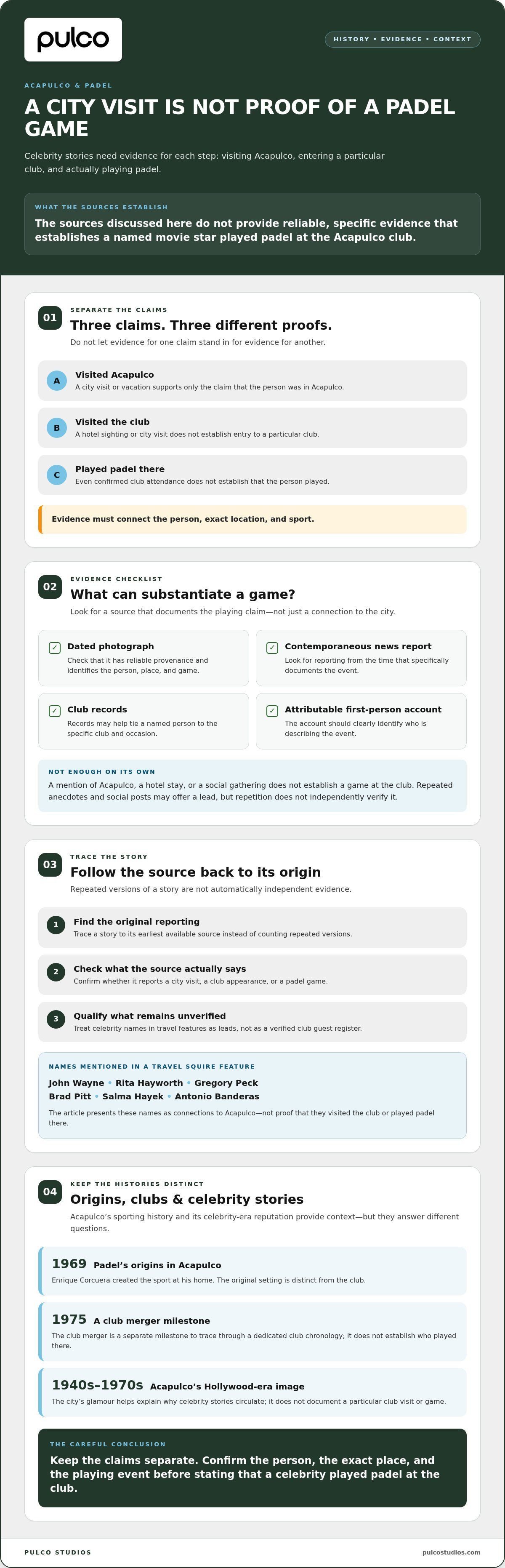
The sources discussed here do not provide reliable, specific evidence that establishes a named movie star played padel at the Acapulco club. Reports connecting celebrities to the city do not prove a club visit, and a club visit would not, on its own, prove that anyone played. The claim “Many famous movie stars and other celebrities visited Acapulco for vacations. Many played padel at the club” combines separate stories that need separate sourcing.
What counts as evidence that a celebrity played padel there?
Look for evidence that connects the person, exact location, and sport: a dated photograph with reliable provenance, a contemporaneous news report, club records, or an attributable first-person account. A source that mentions only Acapulco, a hotel, or a social gathering does not establish a game at the club. Repeated anecdotes and social posts can point researchers toward a lead, but repetition does not independently verify it.
Which celebrity stories need careful qualification?
Travel Squire names the people below in connection with Acapulco. The feature does not establish a padel match or a visit to the club for any of them. Its publication date and individual supporting records are not provided in the material reviewed here, so treat these as reported city associations, not verified court appearances.
| Person | Source and date | Claim and evidence strength |
|---|---|---|
| John Wayne | Travel Squire; date not stated in available material | Named in connection with Acapulco. City association reported; club visit and padel play not established. |
| Rita Hayworth | Travel Squire; date not stated in available material | Named in connection with Acapulco. City association reported; no club or playing evidence supplied. |
| Gregory Peck | Travel Squire; date not stated in available material | Named in connection with Acapulco. City association reported; no club or playing evidence supplied. |
| Brad Pitt | Travel Squire; date not stated in available material | Named in connection with Acapulco. City association reported; no club or playing evidence supplied. |
| Salma Hayek | Travel Squire; date not stated in available material | Named in connection with Acapulco. City association reported; no club or playing evidence supplied. |
| Antonio Banderas | Travel Squire; date not stated in available material | Named in connection with Acapulco. City association reported; no club or playing evidence supplied. |
The distinction is straightforward: a reported visitor is not a confirmed club guest, and neither status proves a game. Label celebrity playing claims unverified unless a source specifically documents padel at the club. That standard preserves the appeal of Acapulco’s sporting history without turning an engaging story into a fact.
How to Trace Acapulco’s Celebrity and Padel Stories
A polished anecdote can travel farther than its evidence. To assess a story about a celebrity and Acapulco padel, trace it to the earliest source you can find, then check exactly what that source says. A city visit, a club appearance, and a game are three different claims. Keep them separate as you research and write.
Which sources offer the strongest historical evidence?
Start with contemporaneous newspapers, dated photographs with identifiable provenance, official club records, and reputable biographies. Later travel features can point to names and stories worth investigating, but they are leads rather than substitutes for primary evidence. A first-person recollection may also be useful, especially when the speaker is identifiable. Record when it was given and whether it clearly names the place and activity.
For each claim, build a simple record:
- Person and claim: Who is said to have visited, attended the club, or played padel?
- Source details: Which publication or record makes the claim, and when was it published or created?
- Exact wording: Does the source say “visited Acapulco,” “went to the club,” or “played padel”?
- Source trail: Is this original reporting, or does it repeat another article without adding evidence?
- Assessment: Label the claim as documented, reported, anecdotal, or unverified.
The source trail is especially important. Several articles repeating the same anecdote may all trace back to one unsourced account. They do not automatically provide independent confirmation.
How should conflicting accounts be presented?
Keep each version tied to its own source, date, and location. If one account describes a hotel stay and another mentions a club, do not combine them into a single visit. Quote or paraphrase each claim accurately, then state what the evidence does and does not establish. Avoid adding a precise date, venue, or match detail that the sources do not provide.
Archival records can be incomplete. Finding no photograph or report is not proof an event never happened; it means the claim remains unverified on the evidence available. Say so plainly. “A travel feature reports a visit to Acapulco” is more accurate than presenting someone as a confirmed club guest. Saying that the person “played padel there” requires a source that specifically supports that detail.
The sentence “Many famous movie stars and other celebrities visited Acapulco for vacations. Many played padel at the club” should therefore be checked as two claims, not repeated as one established fact. For a present-day connection to the city’s sporting culture, explore Acapulco-founded technical padel apparel from Pulco Studios.
Acapulco’s Padel Legacy: From Celebrity-Era Stories to Today
Acapulco’s celebrity-era reputation and its place in padel history meet in the city’s broader sporting and social identity, but they are not the same record. A famous visitor does not establish a club appearance, and a club appearance does not prove a game. Keeping those threads distinct makes Acapulco’s legacy more compelling, not less.
What parts of the club’s legacy are documented?
The clearest historical anchor is padel’s Acapulco origin: Enrique Corcuera created the sport at his home in 1969. That fact should not be transferred to a club without evidence identifying the club, its dates, and its role. A precise account of the club’s legacy depends on dated club records or reputable historical sources, not celebrity anecdotes or the city’s general fame.
An Acapulco heritage article can place the city’s sporting history alongside its social and cultural past. Keep verified club milestones separate from the celebrity narrative. When a record establishes a club date or event, report it with its source. If the record is incomplete, say so rather than filling the gap with a confident-sounding guess.
How does Acapulco’s heritage live on in modern padel?
Padel now has an international professional circuit, and Acapulco is scheduled to host a Premier Padel Major at Arena GNP Seguros from November 23 to 29, 2026. The event connects the city with the sport’s modern global stage. On its own, it does not prove an unbroken line between today’s tournament scene and a particular historic club or celebrity match.
Many played padel at the club” needs the same careful treatment. The city’s fame and the sport’s origins are meaningful parts of the story; the playing claim still needs specific evidence identifying the person, location, and game. Acapulco’s heritage stands on its own without embellishment.
Pulco Studios brings a present-day connection to that heritage: the brand was founded in Acapulco and focuses on technical apparel for padel players. Its roots are contemporary, not proof of historic club events. Explore Pulco Studios’ technical padel apparel and carry a piece of Acapulco’s padel spirit onto court.
Carry Acapulco’s Padel Heritage Forward
Acapulco’s celebrity-era appeal and its place in padel history make a compelling story, but they are not interchangeable evidence. Padel began in Acapulco in 1969; claims about a celebrity visiting a club or playing there need sources that identify the person, place, and event.
The phrase “Many famous movie stars and other celebrities visited Acapulco for vacations. Many played padel at the club” combines a broad tourism story with a specific sporting claim. Treat each part separately. A reported visit to the city is not proof of a club appearance, and a club appearance alone does not document a match. This care lets Acapulco’s sporting identity stand on its own, grounded in the history that can be supported.
That heritage also has a modern expression. Pulco Studios was founded in Acapulco and specializes in technical apparel for padel players, connecting the city’s roots with today’s international game. Explore Pulco Studios’ technical padel apparel and take Acapulco’s padel spirit onto court.
Frequently Asked Questions
Which famous actors visited Acapulco?
Travel Squire names John Wayne, Rita Hayworth, Gregory Peck, Brad Pitt, Salma Hayek, and Antonio Banderas in connection with Acapulco. Treat these as reported city associations, not proof that each person’s visit has independent archival confirmation. A reliable biography, dated newspaper report, or archive can help verify an individual claim. None of the names, by itself, establishes a visit to the Acapulco Diving and Padel Club or participation in a padel match.
Did Hollywood stars play padel at the Acapulco Diving and Padel Club?
No specific celebrity’s play at the club should be presented as established without direct supporting evidence. A city visit or hotel stay does not document a club appearance, and club attendance alone does not prove a game. Strong evidence would identify the person, the club, and padel specifically, ideally through a dated photograph, club record, contemporaneous report, or attributable first-person account. Without that, describe the playing story as unverified.
What is the connection between Acapulco and padel?
Acapulco is where Enrique Corcuera created padel in 1969, according to the historical accounts cited in this article. That origin connects the city to the sport, but it should not be conflated with the history of a particular club. The club’s own timeline requires separate records. For more context, read the dedicated article on padel’s Acapulco origins, which covers the broader invention story.
When was the Acapulco Diving and Padel Club established?
An establishment date should be stated only when a reliable club record or historical source clarifies what the date represents. A founding, merger, name change, and opening of facilities are different milestones. The club-merger account offers further chronology, but its records need to be considered before treating any date as the club’s founding. Until then, it is more accurate to leave the establishment date open than to guess.
Is there proof that famous visitors played padel in Acapulco?
Proof that someone visited Acapulco does not prove they went to a club or played padel there. Many played padel at the club” contains separate claims that need separate evidence. Look for documentation naming the person, location, activity, and date. Repeated retellings can help locate an original source, but they are not independent confirmation if they all repeat the same anecdote.
Why was Acapulco popular with celebrities?
Acapulco’s reputation as a glamorous international destination was especially strong from the 1940s through the 1970s. Travel features describe the city through its celebrity associations and resort appeal. Those accounts help explain its place in popular culture, but individual visits still need source-specific verification. The city’s tourism history is separate from padel participation: a celebrity connection to Acapulco does not establish a club visit or a match.
Where can I read more about padel’s history in Acapulco?
Look for the dedicated article on padel’s 1969 Acapulco origins for the broader invention story, and the separate club-merger article for details about the club’s chronology. They address different questions: where the sport began and how the club’s history developed. Keep those timelines distinct when evaluating celebrity stories. A reference to the city’s origins or a club milestone does not, on its own, verify that a famous visitor played there.
