


The claim that “Acapulco Diving & Padel Club merged in 1975” is not established by the historical record available here. It should not be presented as fact or confused with padel’s better-documented beginnings.
If you’re tracing Acapulco’s sporting heritage, the dates can be easy to blur. Padel is commonly traced to 1969, when Enrique Corcuera created a court at his private home in Acapulco. That origin story is separate from the supposed club merger, for which reliable evidence identifying the club, the organizations involved, or the event itself has not been established.
This article separates what can be established from what is repeated without clear sourcing. It outlines padel’s reported spread from Corcuera’s home to Spain and Argentina in the mid-1970s, explains why that chronology does not verify an Acapulco merger, and offers practical ways to assess the claim. The result is a clearer account of Acapulco’s place in padel history without turning an unverified club story into fact.
Key Takeaways
- Assess the claim that Acapulco Diving & Padel Club merged in 1975 against dated records, not repetition alone.
- Identify what evidence would clarify whether the claim concerns organizations, facilities, memberships, or activities.
- Keep the reported 1975 club story separate from padel’s commonly cited 1969 beginnings.
- Place Acapulco’s local sporting history in context without overstating one event’s influence on padel’s growth.
- Distinguish what the merger claim establishes from what remains unproven.
What was the Acapulco Diving & Padel Club merger in 1975?
The historical record available here does not reliably establish that the Acapulco Diving & Padel Club merged in 1975. The claim cannot be presented as a confirmed event, and the organizations or activities supposedly involved have not been identified.
In historical terms, a merger means that organizations combine, or that their facilities, memberships, or operations come together under a shared structure. These are different possibilities and require different evidence. Definition: The alleged 1975 merger of the Acapulco Diving & Padel Club is an unverified historical claim; reliable evidence has not established the date, parties, or nature of any merger.
Which organizations or activities came together?
No documented parties can be named with confidence. “Diving & Padel Club” could refer to one organization, a shared facility, or a later description of separate activities. The name alone does not establish which. Without a contemporary record or reliable institutional history identifying the parties, it would be misleading to say that clubs, memberships, courts, or programs combined.
A strong account would name the organizations and explain what changed, using evidence such as dated club records or contemporaneous reporting. When you encounter a retelling, check whether it cites a source that provides those details. Repetition across accounts is not independent confirmation if they all trace back to the same unsupported claim.
Why does 1975 matter in Acapulco padel history?
The date matters only if the local event can be substantiated. A documented merger could help explain how padel was organized or played in Acapulco, but no specific consequence can currently be attributed to it. The sport’s commonly cited origin is separate: padel is traced to 1969, when Enrique Corcuera created a court at his Acapulco home. The broader history of padel provides context, but it does not verify this local merger claim.
That distinction matters. Even if a 1975 club event is proven, it would be a chapter in the sport’s local history, not its invention. For the commonly cited starting point, read more about the 1969 origins of padel in Acapulco. Keeping the timelines separate recognizes the city’s established role without blurring it with an unsupported date.
From padel’s 1969 beginnings to the club’s 1975 chapter
The chronology contains two different levels of certainty: padel’s Acapulco origin is widely documented, while the supposed 1975 club merger remains unverified. Keep the dates distinct. “Acapulco Diving & Padel Club merged in 1975” describes a claim, not an established milestone.
What is commonly reported about padel’s 1969 origin?
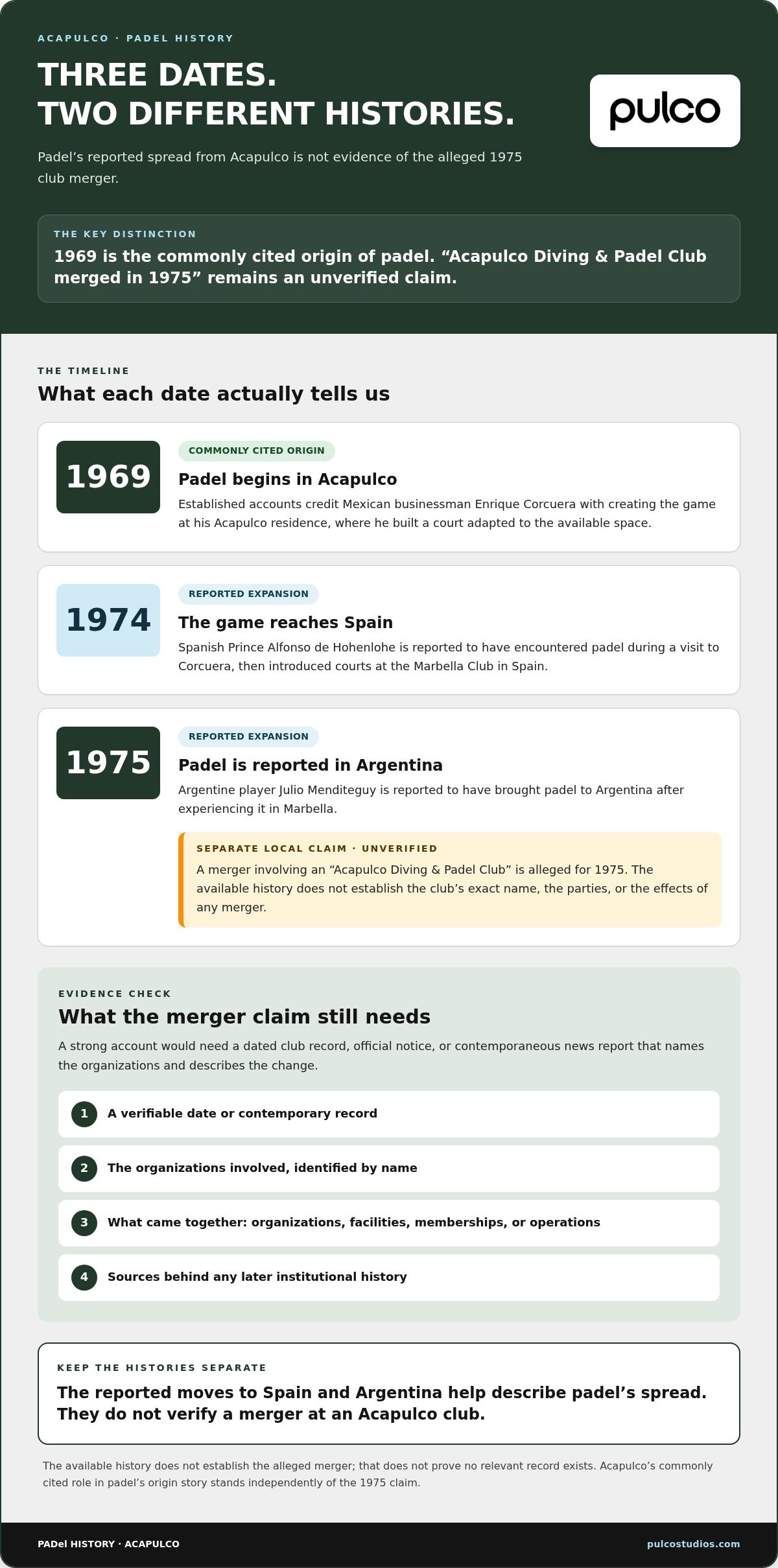
1969, documented in established accounts: Mexican businessman Enrique Corcuera is credited with creating padel at his Acapulco residence, where he built a court adapted to the available space. This is the sport’s commonly cited origin, not evidence of a formal club merger. The Acapulco heritage of cliff diving and padel offers a broader view of the city’s sporting identity. For institutional context, the International Padel Federation is the sport’s international governing body.
What changed between the origin story and 1975?
A few reported developments help bridge the dates, but they do not establish what happened at a particular Acapulco club:
- 1969, established origin account: Corcuera’s home court in Acapulco is widely identified as the starting point for padel.
- 1974, reported expansion: Spanish Prince Alfonso de Hohenlohe is reported to have encountered the game during a visit to Corcuera, then introduced courts at the Marbella Club in Spain.
- 1975, reported expansion: Argentine player Julio Menditeguy is reported to have brought padel to Argentina after experiencing it in Marbella.
- 1975, uncertain local claim: A merger involving an “Acapulco Diving & Padel Club” is alleged, but the available history does not establish the club’s exact name, the parties, or the effects of any merger.
Chronology in one sentence: Padel is commonly traced to Corcuera’s Acapulco court in 1969; the alleged 1975 club merger is a separate, unverified local claim, not the sport’s origin.
The reported moves to Spain and Argentina show how padel began to spread beyond Acapulco, but they do not prove a connection to a local merger. International growth cannot fill gaps in club records. Acapulco’s place in padel’s origin story stands on its own. Pulco Studios has a contemporary connection to the city through its Acapulco roots and padel apparel.
What the available history says, and what still needs proof
The evidence available here does not establish that Acapulco Diving & Padel Club merged in 1975. The claim lacks a cited contemporary document or reliable institutional history that identifies the date, parties, and nature of the supposed merger. This limits what can responsibly be stated; it does not prove that no relevant record exists.
To support a firm account, look for a dated club record, official notice, or contemporaneous news report naming the organizations and describing the change. Later histories can also be useful, but their value depends on whether they identify their sources. A polished retelling or promotional page is not the same as firsthand documentation.
How strong is the evidence for the 1975 date?
Based on the historical material available here, the date remains uncertain. No verifiable publication details or primary record have been identified that explicitly documents a merger. The table below separates the claim from better-supported context and shows what remains unresolved.
| Claim or evidence | What it supports | Status |
|---|---|---|
| A club merger occurred in 1975 | No dated record naming the parties or describing the merger has been established. | Unverified |
| The club’s exact name and organizations involved | The available account does not identify verifiable names or explain what combined. | Uncertain |
| Padel began in Acapulco | Widely reported histories trace the game to Enrique Corcuera’s Acapulco court. | Established context, separate from the merger claim |
| Later accounts repeat the merger story | Repetition alone does not show that each account relies on independent evidence. | Requires source tracing |
How can readers distinguish fact from repeated club lore?
Start by checking where the account comes from. A record created at the time is different from a later recollection, though either may be useful if its origin is clear. For a recollection, look for the speaker’s name, when the account was given, and whether the person had direct knowledge. For a web page, see whether it cites a document or repeats wording found elsewhere.
Independent coverage of padel’s Mexican heritage can establish broader context, but it does not automatically verify this particular club event. For example, Mexico News Daily’s account of what Acapulco gave the world discusses the sport’s local history and recognition of founder Enrique Corcuera. It should not be treated as proof of a 1975 merger unless it documents that claim directly.
Use the claim as a lead, not a fact, until evidence connects a date, named parties, and a specific change. A missing citation in one search result does not disprove the event. It does mean that certainty is premature.
How to read the Acapulco club merger in its local context
If documented, a club merger could show how padel was organized in one part of Acapulco: which groups shared facilities, how memberships changed, or whether activities came under one institution. That would add valuable local detail. On its own, however, it would not show that the club represented every player in the city or drove the sport’s wider development.
For now, Acapulco’s established connection to padel and the alleged merger rest on different levels of evidence. Acapulco is widely recognized in accounts of the sport’s beginnings. The claim that “Acapulco Diving & Padel Club merged in 1975” remains unverified, including the meaning of “merger” in this case. Any suggestion that the event transformed local padel is an interpretation until a source documents both the event and its consequences.
What can a club merger reveal about padel’s early community?
A reliable record could show how a particular community organized its sporting activities. But a club’s history is not automatically the history of an entire city. To support a wider claim about Acapulco’s players, facilities, or padel culture, the evidence would need to show how the club connected to that broader community. Without that link, keep the conclusion narrow: a merger may illuminate one institution, not the whole sport.
How does diving fit into the Acapulco heritage story?
Diving and padel can both form part of Acapulco’s sporting identity, but sharing a location does not prove that their organizations merged or operated together. That connection requires direct evidence, such as a record naming both parties and describing their relationship. The Acapulco cliff-diving and padel heritage guide offers broader local context; it should not be mistaken for proof of a specific club event.
Use this checklist to assess an account of the merger:
- Date: Does a dated source support 1975?
- Parties: Does it name the organizations and use historically documented spellings?
- Source: Is it a contemporary record, an attributable recollection, or a later retelling?
- Consequence: Does the source explain what changed, or does the account infer an impact?
This distinction keeps Acapulco’s sporting heritage vivid without stretching the evidence. Explore padel apparel with Acapulco roots from Pulco Studios.
Why Acapulco’s padel heritage still resonates today
Acapulco’s place in padel history does not depend on an unverified club story. The city is widely associated with the sport’s early beginnings, while the claim that “Acapulco Diving & Padel Club merged in 1975” is not substantiated by the historical evidence available here. The specific merger, its participants, and its consequences have not been confirmed.
What should readers remember about the 1975 merger?
Keep the two historical questions separate. Padel’s commonly cited 1969 origin in Acapulco is distinct from the alleged 1975 club merger. The first belongs to the sport’s origin story; the second would be a local institutional event if reliable records establish it. Until evidence identifies the date, parties, and what changed, do not describe the merger as fact or credit it with shaping the sport’s growth.
This distinction does not diminish Acapulco’s heritage. It makes the account stronger: the city’s connection to padel can be recognized without relying on one uncertain club claim to explain the sport’s wider history.
Where can readers explore more of Acapulco’s padel story?
For the sport’s early history, read about the padel origins in Acapulco. Pulco Studios was founded in Acapulco, a meaningful part of its brand context, but that does not establish an affiliation with the club or the alleged merger.
For a practical next read, explore Pulco Studios’ padel clothing essentials guide. The heritage is Acapulco’s, and the evidence deserves the same precision as the game.
Carry Acapulco’s padel story forward
Acapulco’s place in padel history is compelling without overstating what the records show. The sport’s commonly cited 1969 beginnings are separate from the unverified claim that Acapulco Diving & Padel Club merged in 1975. The merger’s date, parties, and consequences remain uncertain, so it should not be presented as established fact or as the event that drove padel’s growth.
That distinction leaves room for Acapulco’s heritage to resonate. A well-sourced local club history could add detail to the city’s sporting past, while its association with padel stands independently of the unresolved claim.
Pulco Studios is an independent padel apparel brand founded in Acapulco. Its roots connect contemporary padel culture with the city’s heritage without implying a relationship to the club in question. Explore technical padel apparel, including Aircon playing shirts, the Coaches Rain Jacket, and the CIMORO x PULCO Padel Pack, at Pulco Studios. Keep the history sharp, and carry its spirit onto the court.
Frequently Asked Questions
Did the Acapulco Diving & Padel Club merge in 1975?
No reliable evidence currently establishes that the Acapulco Diving & Padel Club merged in 1975. The claim remains unverified: available accounts do not identify the organizations involved, explain what combined, or cite a contemporary record confirming the date. That does not prove the event never happened. It means the merger should be described as an unresolved claim unless stronger documentation emerges.
Was padel invented in Acapulco in 1969 or formed through the 1975 merger?
Padel’s commonly cited origin is 1969 in Acapulco, not a 1975 merger. Established accounts credit Enrique Corcuera with creating the game at his home. The alleged club merger is a separate claim about local sporting history, and its date and details remain uncertain. Even if future evidence confirms a club merger, that would not change the distinction between the sport’s reported invention and a later institutional event.
What happened at the Acapulco Diving & Padel Club in 1975?
What happened there in 1975 cannot be established from the reliable evidence currently available. The club’s exact historical name, any organizations or activities involved, and the supposed merger’s consequences remain unclear. A precise account would require a dated source that identifies the parties and describes what changed. Until then, label the story unverified rather than state that a merger definitely took place.
Who founded padel in Acapulco?
Enrique Corcuera is commonly credited with creating padel in Acapulco in 1969. Historical accounts describe him building a court at his home, where the game took shape. This origin story is distinct from the unverified 1975 club-merger claim. When tracing the sport’s beginnings, rely on accounts that identify their sources and distinguish documented history from later retellings.
How did padel spread from Mexico to Spain?
Accounts commonly describe Spanish Prince Alfonso de Hohenlohe encountering padel during a visit to Enrique Corcuera in Acapulco in 1974. He then introduced courts at the Marbella Club in Spain, helping the game take root there. This reported step in padel’s spread offers useful context, but it does not verify or explain the separate claim of an Acapulco club merger in 1975.
What sources can verify the 1975 club merger?
The strongest evidence would be a dated club record, official notice, or contemporary news report naming the organizations and explaining what merged. A later institutional history may also help if it cites its sources. Retrospective accounts and online repetition can point to a lead, but they do not independently confirm it. No reliable source identified here establishes the merger’s date, parties, or consequences.
Why is Acapulco important to padel history?
Acapulco is important because padel’s commonly cited origin places Enrique Corcuera’s first court there in 1969. The city is central to the sport’s origin story, regardless of whether the separate 1975 merger claim is ever verified. A careful history recognizes Acapulco’s role without suggesting that one uncertain club event explains padel’s later development or international growth.
